Introduction
Selecting the correct strip brush filament is the single most important factor in determining brush performance, lifespan, and total cost of ownership. Whether you need a brush for door sealing, conveyor cleaning, CNC deburring, or industrial surface treatment, the filament material must match the operating environment.
At Classic Brush, we manufacture OEM strip brushes with a wide range of filament options—from flexible nylon to high‑temperature resistant stainless steel and abrasive-filled variants. This guide walks you through the key filament types, their properties, and how to match them to your specific application.

Why Filament Selection Matters
The filament is the working part of any strip brush. A mismatch leads to:
- Premature wear (costly replacements)
- Poor sealing or cleaning performance
- Damage to sensitive surfaces
- Safety risks (e.g., sparking in flammable environments)
A well-chosen filament delivers 2–5× longer service life and reduces downtime.
Common Strip Brush Filament Materials
- Nylon 6/66 (Most Popular)
Properties:
Excellent abrasion resistance
Absorbs less moisture than nylon 6 (critical for humid environments )
Operating temperature: up to 250°F (120°C)
Available in various diameters
Best for:
Door and elevator seals
Conveyor belt cleaning
Food processing equipment (FDA grades available)
General-purpose dusting
Why choose nylon strip brush: It offers the best balance of flexibility, durability, and cost. For most industrial sealing applications, nylon 6/66 is the default choice.
- Polypropylene (PP)
Properties:
Chemical resistant
Stiffer than nylon
Lower moisture absorption
Temperature range: up to 180°F (82°C)
Best for:
Chemical washdown areas
Battery plants
Applications where acid/alkali exposure is frequent
Limitation: Brittle in cold temperatures; not recommended for freezing environments.
- Stainless Steel (SS 304/316)
Properties:
High-temperature resistance (up to 800°F / 427°C)
Non-sparking (safe for explosive atmospheres)
Excellent for heavy-duty scrubbing
Corrosion-resistant (316 grade for marine/coastal)
Best for:
Oven door seals
Welding spark protection
Metal surface preparation
Marine and offshore equipment
Why choose stainless steel strip brush: When heat, sparks, or aggressive cleaning is involved, stainless steel outperforms all synthetic filaments.
How to Match Filament to Your Application
Step 1: Define the Operating Environment
- Temperature: Will the brush be near ovens, furnaces, or outdoor heat?
- Moisture/Chemicals: Exposure to water, oil, solvents, or salt spray?
- Surface type: Hard metal, soft plastic, glass, or food products?
Step 2: Determine the Brush Function
- Sealing: Needs flexible, dense filament (nylon or PP)
- Cleaning: Requires stiffer filament with good bend recovery (nylon or SS)
- Deburring: Abrasive-filled or stainless steel
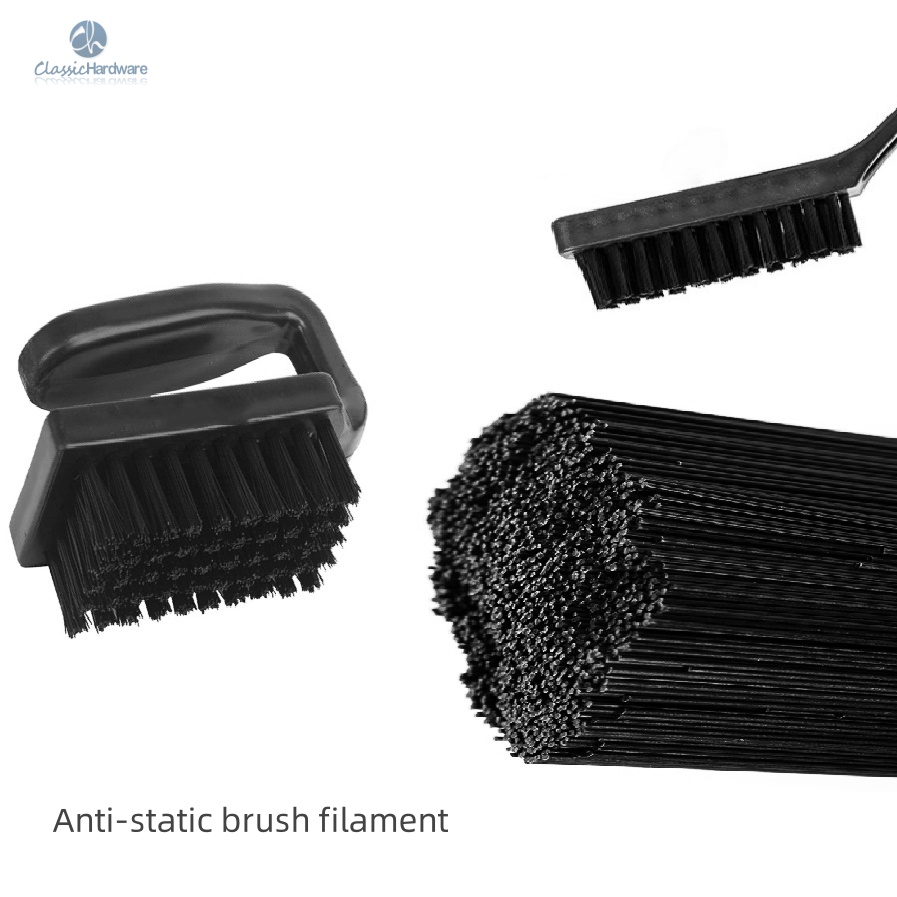
- Static control: Conductive filament (brass, carbon-filled nylon)
Step 3: Choose Filament Diameter and Trim Length
- Heavy-duty: 0.020″–0.040″ diameter
- Fine work: 0.008″–0.012″ diameter
- Trim length: Longer trim = more flexible; shorter = stiffer

Not sure which filament fits your application? Send us:
Application description (sealing, cleaning, deburring, etc.)
Operating temperature and environment
Surface material and required finish
Dimensions (length, backing width, filament length)
We’ll reply within 24 hours with a specification sheet and quote.
📧 Email: don@metalbrush.com
📱 WhatsApp: +86-13535171278
📍 Factory: #9 Lingxing Industrial Park, Panyu, Guangzhou, China